

From Ghost Trains in the Sky to Ghost Files on Your Phone
A Real Guide to Staying Connected
We live our lives in three places at once out in the real world, glued to a phone screen, and now, increasingly, looking up at a sky full of man-made satellites. Whether you’re checking where your friends are on a map, trying to figure out what that strange line of lights was last night, or wondering why your phone suddenly won’t save another photo, it all comes down to the same thing: understanding the systems running quietly in the background of daily life.
Why Everyone’s Suddenly Talking About the “Ghost Train”
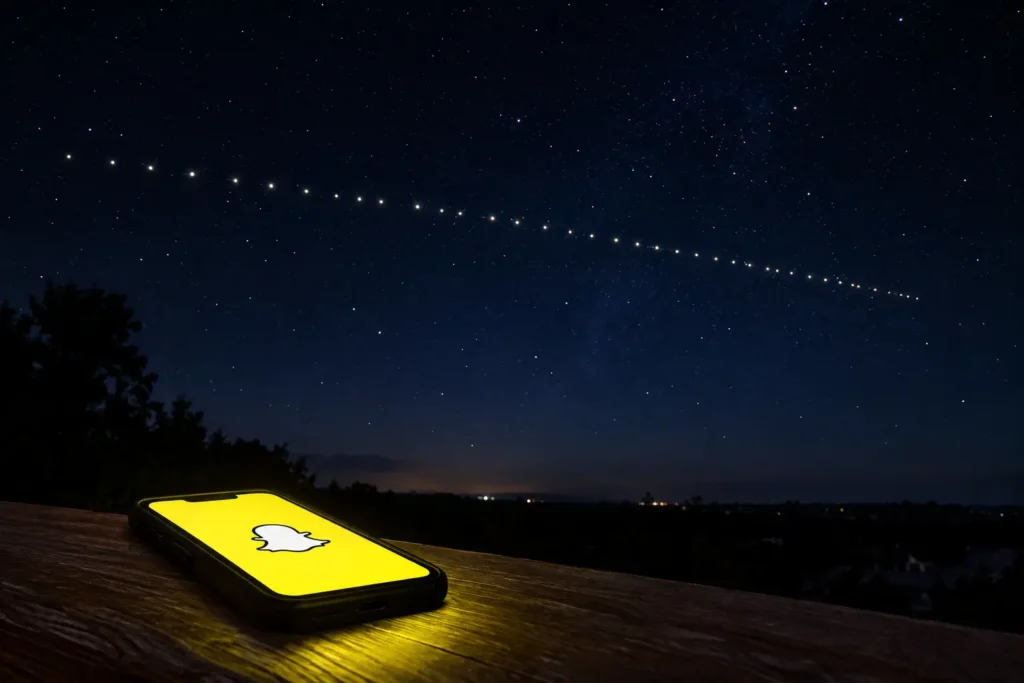
If you’ve spotted a straight line of glowing dots gliding silently across the night sky and assumed you’d witnessed something otherworldly, you’re not alone and you’re also not wrong to be curious. That formation, nicknamed the “Ghost Train” by skywatchers, is a batch of Starlink satellites that SpaceX has just launched into low Earth orbit.
Here’s what’s actually happening: satellites are deployed from the rocket in a tight cluster, and for the first several days to weeks after launch, they haven’t yet spread out into their working orbital positions. During that window, they trail one another closely enough to look like a single connected object a “train” as they catch sunlight and reflect it back to us on the ground, usually most visible just after sunset or before sunrise. Once each satellite raises its orbit and moves into its assigned “shell,” the formation breaks apart and becomes far less noticeable, blending into the thousands of other satellites already in orbit.
It’s a fitting parallel to how we track each other day to day. Apps like Snapchat’s Snap Map turned location-sharing into something casual and constant a little dot moving across a map, updating in near real time. Just as astronomers watch satellite trains resolve into their final formation, our friends’ map avatars shift and settle as we go about our day. Same basic idea visibility, movement, connection just playing out on two very different scales.
The Solar System, Explained Like Your Friend Group
Planets are easier to remember when you stop thinking of them as facts to memorize and start thinking of them as personalities in a group chat
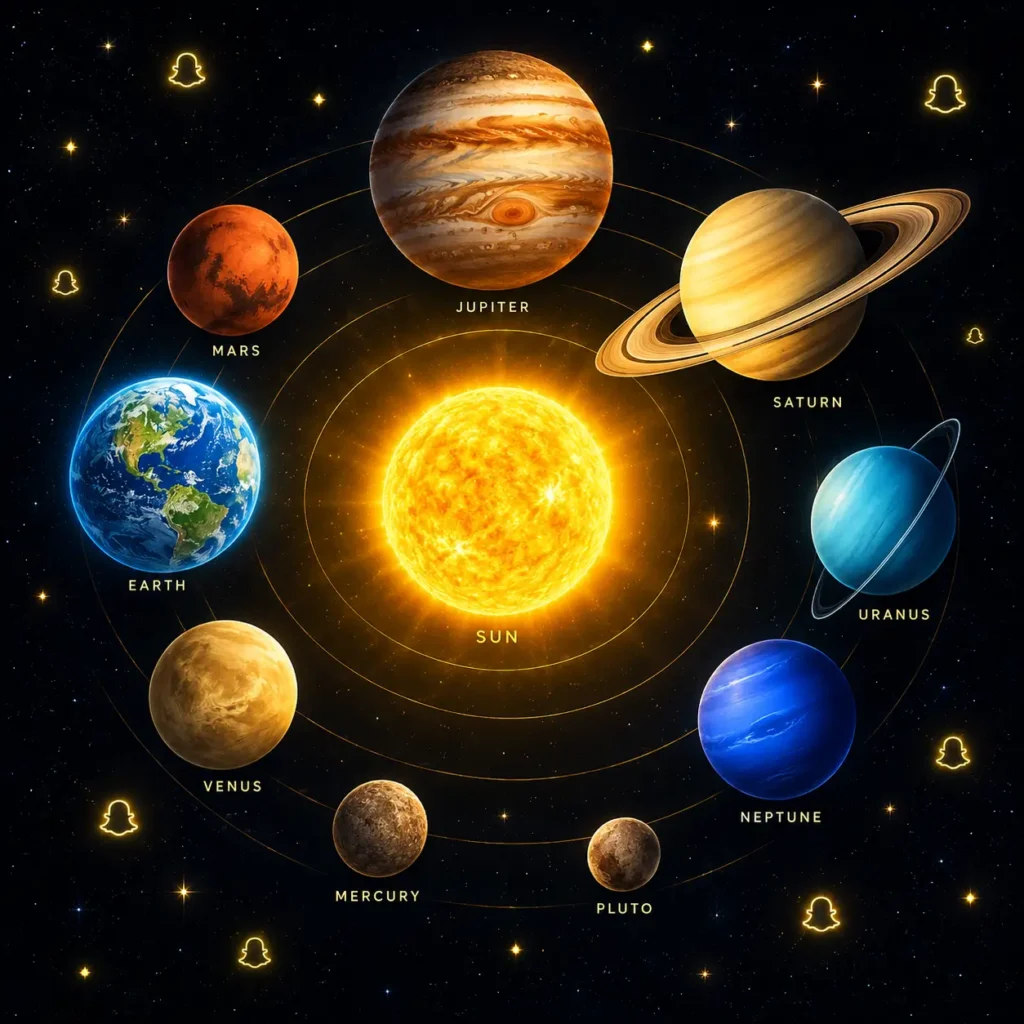
- The Sun the anchor. Nothing in this group moves without gravity pulling it back toward the Sun. It’s the reason the whole circle holds together at all.
- Mercury and Venus the intense ones. Mercury is the friend who’s always in a rush; it completes a full orbit in just 88 days, the fastest of any planet. Venus, meanwhile, runs hot in the other sense a thick, carbon-dioxide-heavy atmosphere traps heat so effectively that its surface is hotter than Mercury’s, even though Mercury sits closer to the Sun.
- Earth the stable one. The only member of the group where the conditions line up just right for liquid water and, as far as we know, life.
- Mars the ambitious one. Rusty red, dry, and the current target of most of humanity’s exploration plans, from rovers to future crewed missions.
- Jupiter the protector. Its enormous mass gives it a gravitational pull strong enough to fling or capture asteroids and comets that might otherwise threaten the inner planets a real effect, not just a nice metaphor.
- Saturn the stylish one. Best known for its rings, made of countless chunks of ice and rock, some as small as dust and others as large as houses.
- Uranus and Neptune the distant ones. Ice giants so far out that Neptune takes about 165 Earth years to complete a single orbit. They’re cold, quiet, and rarely visited only one spacecraft, Voyager 2, has ever flown past either of them.
Why Your Phone Slows Down (And Why the Date Matters More Than You Think)
Every time you take a photo, share your location, or open an app, your phone is quietly building up small temporary files in the background. Left unchecked, this buildup is one of the most common and most overlooked reasons phones start lagging, apps start crashing, or storage fills up faster than expected.
One surprisingly common culprit is something people rarely think to check: the device’s date and time settings. Apps and websites rely on accurate timestamps to verify secure connections and encryption certificates. When a phone’s clock drifts or gets set incorrectly, you can end up with location data that lags behind reality, photos that file themselves under the wrong date, or apps that fail to load at all because a security check silently fails.
To fix this
- On Android: Settings → System or General Management → Date and Time → turn on “Automatic date and time” or “Use network-provided time.
- On iPhone: Settings → General → Date & Time → turn on “Set Automatically.
Cache vs. Data: Know the Difference Before You Tap Anything
This is where a lot of people accidentally lose things they didn’t mean to. “Clear cache” and “clear data” sound similar, but they do very different things:
- Clear cache removes small temporary files thumbnails, preloaded stickers, lens graphics that apps store just to load faster. It does not touch your saved content or login.
- Clear data wipes the app back to its factory state, including local databases and saved logins. This should be a last resort, not a routine habit.
How to Clear Snapchat’s Cache Without Losing Your Memories or Chats
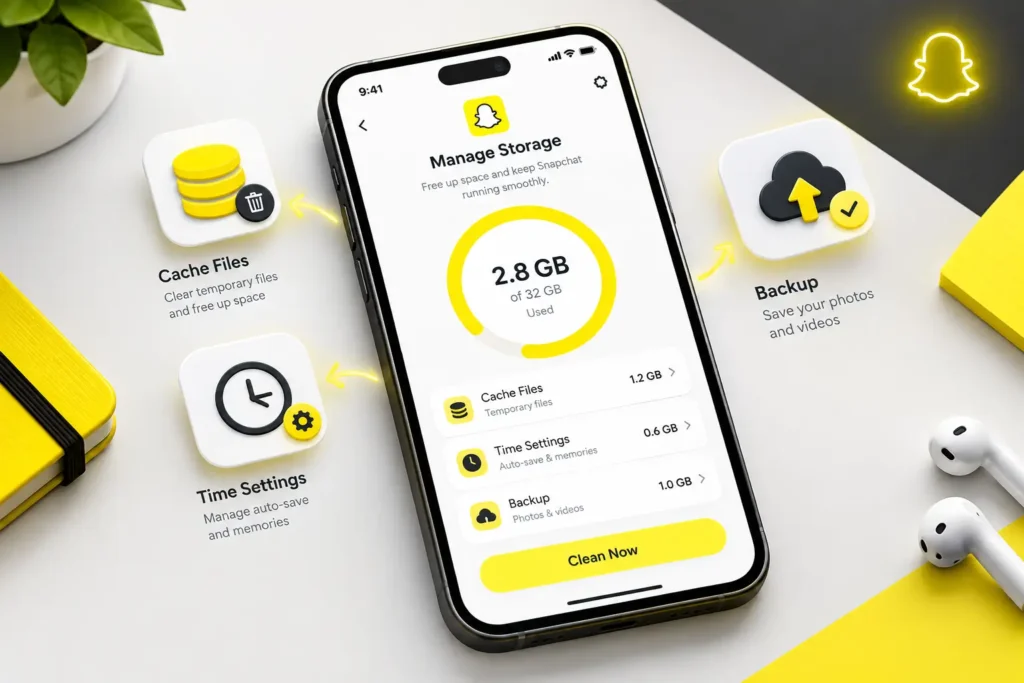
This is one of the safest, most misunderstood pieces of phone maintenance. Snapchat’s local cache thumbnail previews, lens and filter files, temporary Story data is completely separate from your Memories, which live on Snapchat’s servers, and your chats, which sync to your account. Clearing the cache only removes the local junk; nothing tied to your account is touched.
On iPhone
- Open Snapchat and tap your profile icon (top-left).
- Tap the gear icon to open Settings.
- Scroll to “Privacy Controls” and tap “Clear Data.
- ” Tap “Clear Cache,” then confirm.
- Tap “OK” to let Snapchat restart.
On Android
- Open Snapchat, tap your profile icon, then the gear icon for Settings.
- Scroll to “Account Actions” and tap “Clear Cache.
- ” Tap “Continue” to confirm.
You can also clear it without opening the app at all: go to your phone’s Settings → Apps → Snapchat → Storage & Cache → Clear Cache. Either way, your Snaps, Memories, and saved conversations stay exactly where they are you’re just clearing out the digital clutter that piles up behind the scenes. Since Snapchat is a heavy media app, doing this once a month if you’re a regular user is enough to keep things running smoothly.
Backing Up Your Snaps to Both Your Gallery and the Cloud
Relying on a single copy of your memories is risky phones get lost, apps get uninstalled, accounts occasionally have hiccups. Snapchat actually gives you a way to cover both bases at once: your device’s Gallery and the cloud.
Step 1 Turn on Auto Save to your device
- Open Snapchat and tap your profile icon.
- Go to “Memories” and tap the gear icon in that section.
- Turn on “Auto-Save My Snaps and Auto-Save My Stories, if you want those too.
- From here on, everything you capture saves automatically to your phone’s Camera Roll or Gallery no manual downloading needed.
Step 2 Back up to the cloud on top of that
- Snapchat’s Memories feature is itself cloud-based and syncs automatically once you’re logged in, meaning your content is retrievable from any device where you sign in.
- For an extra layer of protection, turn on your phone’s own cloud backup iCloud Backup on iPhone (Settings → [your name] → iCloud → iCloud Backup) or Google Photos backup on Android so your Gallery copies are also mirrored off the device itself.
- If you want a portable archive you control, Snapchat also lets you export your Memories as a downloadable file from Settings → Memories → Export Snaps, which you can then upload to Google Drive, Dropbox, or any cloud storage of your choice.
Doing both device auto-save and a separate cloud backup means a lost phone or a glitchy update can’t quietly wipe out years of saved memories.
Keeping It All Running Smoothly
None of this requires becoming a tech expert. Check your date and time settings once, clear your cache every few weeks if you’re a heavy app user, and set up backups once so you never have to think about it again. Small habits like these are the difference between a phone that stays fast and organized, and one that slowly grinds to a halt under the weight of files you never noticed piling up.
FAQs
Q: Will the “Ghost Train” damage or interfere with normal stargazing?
A: No. It’s a temporary visual usually visible for a few weeks after a launch, before the satellites spread into their final orbits and become far less noticeable.
Q: Is Pluto ever going to be reclassified as a planet again?
A: Unlikely under current rules. It’s classified as a dwarf planet because it hasn’t cleared its orbital neighborhood of other debris the same standard applied to Eris and Makemake.
Q: Does clearing Snapchat’s cache delete my streaks?
A: No. Streaks, chats, and Memories are all tied to your account on Snapchat’s servers, not to the local cache on your device.
Q: How much storage does Snapchat’s Memories actually use on my phone?
A: Very little, if Auto-Save is set to save to Memories only. It’s when Auto-Save also saves a second copy to your phone’s Gallery that local storage fills up faster.
Q: Do I need to clear cache and fix my clock separately, or does one fix the other?
A: Separately they solve different problems. A wrong clock can cause login and security errors; a full cache slows the app down and eats storage. Worth checking both during the same maintenance pass.
Tips & Tricks
- Set a monthly reminder to clear your Snapchat cache if you’re a daily user it takes under a minute and prevents most lag-related complaints.
- Turn on Wi-Fi-only backup for Memories if you’re worried about data charges this avoids surprise cellular usage during auto-save.
- Check your date and time settings first if any app suddenly stops loading or logs you out unexpectedly it’s a five-second fix that solves more problems than people expect.
- Export your Memories once a year as a personal archive, even if cloud backup is already on a local copy protects you if an account ever gets locked or compromised.
- Watch for Starlink trains just after sunset or before sunrise that’s when the satellites catch sunlight against a dark sky, making them easiest to spot.
- Don’t confuse “Clear Cache” with “Clear Data” always double-check which button you’re tapping, since only one of them is fully reversible